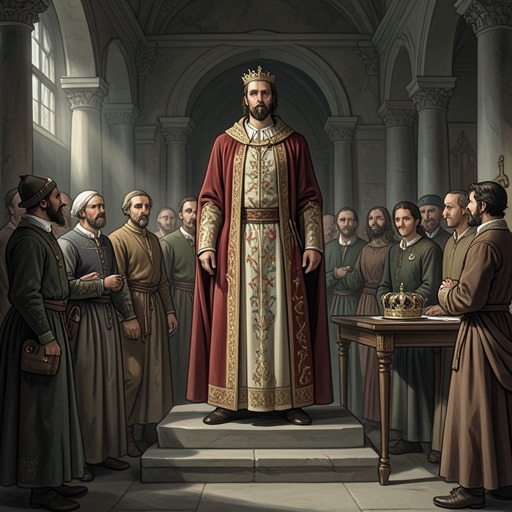
Catalina’s six-year wait to marry Prince Harry (1503–1509)
The Constant PrincessCatalina’s six-year wait to marry Prince Harry (1503–1509) was a period of enforced dependence that tested, and ultimately forged, her resolve to become Queen of England. After the death of Arthur, Prince of Wales, she was left a widow whose future depended on negotiations among the English and Spanish crowns. A disputed dowry, the question of her widow’s support, and the authority of her parents made her marriage to Harry more than a private promise: it was a dynastic settlement she could neither secure nor abandon on her own.
Widowhood and the price of the alliance
The wait began in the shadow of the marriage that had brought Catalina to England. She understood that her wedding to Arthur had been purchased through a vast dowry and prolonged negotiations, but she also remembered a graver cost: Edward Plantagenet, Duke of Warwick, had been executed before her voyage to England. In her understanding, her parents had required Warwick’s death before they would send her, eliminating a rival claimant to the English throne. That knowledge made her arrival feel inseparable from the violence of dynastic security and gave her a powerful sense of personal burden.
After Arthur’s death, Catalina’s position was governed by the terms of her marriage settlement and by the unsettled account between the two royal households. The dowry had not been paid in full. Her parents expected Henry VII of England to return it, while Catalina was also entitled, as Arthur’s widow, to a jointure. Dr. de Puebla explained that the jointure amounted to a third of the revenues of Wales, Cornwall, and Chester. Catalina doubted that Henry would pay either the money or those revenues: he had not even paid her allowance while Arthur was alive, and she saw little reason for him to honor obligations that no longer benefited him.
The financial dispute shaped her daily circumstances as well as her political prospects. In an earlier conversation about the dowry, Margaret Pole understood that Catalina was caught between two determined rulers. The English king wanted the promised cash; Catalina’s father, Ferdinand II of Aragon, had sent only half the sum and suggested that the household goods and plate could make up the difference. At Ludlow Castle, Catalina’s household used her own gold plate, and every use diminished its value as a financial asset. When she later lacked money for food and wages, she sold jewels and pawned the plate piece by piece, knowing that this property was also bound up with the promised marriage.
A marriage promise held in suspension
In 1504, Harry Tudor reached twelve and was declared Prince of Wales, but Catalina was not invested as his princess and their betrothal did not advance. She asked the Spanish ambassador why she had not received the title alongside him. He offered the missing dowry as an explanation, although all parties understood that the depleted plate could not replace the unpaid money and that her father might not send his share. Catalina could not force either court to act. The absence of the title made the delay visible: Harry’s rank had been publicly affirmed, while Catalina remained a supplicant waiting for the promised place beside him.
The obstacles were not solely financial. When Henry proposed that he marry Catalina himself, the ambassador raised the affinity impediment created by her marriage to Arthur. Henry said he would seek a dispensation and asked whether the earlier marriage had been consummated; Dr. de Puebla confirmed Catalina’s account that it had not. But the possibility of a marriage to Henry depended on her parents’ cooperation. The ambassador stressed that without their request for a papal dispensation there could be no marriage. Catalina’s obedience as a Spanish princess was therefore both a constraint and a diplomatic instrument: her parents could refuse Henry and direct the settlement back toward Harry.
Dr. de Puebla described the alternative arrangement as a way to end the financial deadlock. If Catalina were betrothed to Harry, Spain would pay the second half of the dowry, and her widow’s jointure would cease; Henry would again control the revenues of Wales, Cornwall, and Chester. The proposed match thus reconciled competing claims by tying Catalina’s future to the settlement of money, income, and royal succession. Henry, who had mistaken her attention for personal desire, learned that her parents would permit her to marry Harry or return to Spain, but would not consent to his proposal.
The years of waiting
Catalina later counted the delay as six years, from seventeen to twenty-three, and described it not as a romantic interval but as a sentence of loneliness and captivity. Harry was still a child, scarcely seen by her and unable to make the promise good. Each birthday added another year without a marriage: he was fourteen, then fifteen, sixteen, and seventeen, while nobody came for her. The repetition turned waiting into the defining action of the period. With no leverage over the king and no dowry payment from Spain, she could not make the English court honor the betrothal by force of will alone.
Her poverty made that powerlessness material. Catalina altered the panels of her gowns and sold her jewels to buy food. She sent for goldsmiths to pawn the household plate, aware that each piece sold reduced what remained for the marriage settlement. Her household also needed to eat, and she could not ask its members to go without wages and food simply to preserve her assets. The conflict between maintaining the resources meant to secure her future and meeting immediate necessities left her forced to consume the very wealth on which her future claim depended.
She also lost the support of Doña Elvira after discovering that Elvira was plotting against her father in favor of Juana of Castile and her husband, Philip of Habsburg. Catalina dismissed her in anger, accepting the risk that Elvira might attack her reputation, including the account of her marriage to Arthur. The decision deepened her isolation, but Catalina judged that Elvira’s word would not outweigh her own. She did not pursue the loss or complain of it; the rupture became another cost she chose to bear rather than align herself against Ferdinand.
Her mother, Isabella of Castile, was distant during the wait. Catalina imagined herself sent into the world without companions or a map, and feared that her mother was ashamed of her. In November, anxious that Isabella might be ill or unhappy, she wrote begging for a reply. Isabella died on the very day Catalina sent the letter, so it never reached her and no answer came. Her mother’s death left Catalina with the sense that silence and absence had followed her from life into death, and made the prospect of returning to Spain no simple restoration of home.
Maturity, persistence, and settlement
Catalina distinguished these years from defeat. Though she lost confidence in her beauty, intelligence, and abilities, she did not give up her will to live. She drew strength from memories of childhood in the Alhambra and from her love for Arthur. In her account, she also carried forward the determination and courage of Isabella and the optimism she associated with Arthur. The transformation was bitter: she had arrived as a young bride ready for love and became, at twenty-three, a lonely widow without husband, mother, friends, fortune, or clear prospects. Yet she continued to imagine herself as England’s future queen.
The opening for a settlement came when Mary Tudor’s planned marriage into the Habsburg family altered the diplomatic circumstances. Ferdinand at last sent the money for Catalina’s dowry to London. Catalina greeted the news as release: with the payment, a double wedding could be arranged, and she could marry Harry. The prospect followed years in which each delay had seemed to confirm that the promise would never be honored. When an emissary finally told her she would be Queen of England, Catalina answered that this had always been her destination. After the long wait, she knelt in her chamber and addressed Arthur, telling him that Harry would marry her and that she had done what Arthur had wished.
The persistence developed during the delay later shaped how Catalina defended her queenship. In the marriage proceedings, she entered the court despite having prepared no legal defense and despite making clear that she did not recognize the tribunal. Her position depended on the claim that her marriage to Arthur had not been consummated; she privately acknowledged that the claim was a lie and believed Henry would not publicly challenge it face to face. The wait had taught her how little protection a royal promise offered without money, consent, or power. It had also made constancy a political resource: the woman who had been left waiting now stood before the court to defend the identity she had spent those years insisting she would attain.